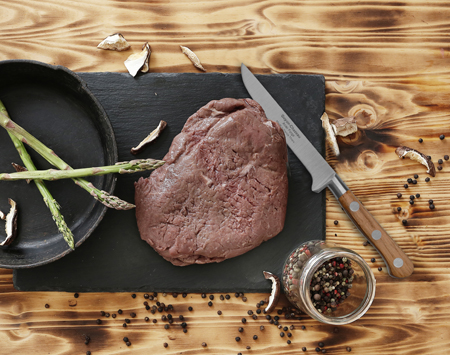
What kind of knife should you use to slice cooked meat?

An unsuitable knife crushes the fibers, causes the juice to leak out, and leaves uneven slices that dry out in a matter of minutes.
In contrast, a good blade glides effortlessly, preserves the tenderness, and enhances the final result.
There’s one question that seems simple: What kind of knife should you use to carve cooked meat?
The answer depends mainly on the cut of meat you’re carving.
An overview of Coutellerie Goyon-Chazeau, an artisanal cutlery manufacturer based near Thiers since the 1950s.
Why does the choice of knife make all the difference when it comes to cooked meat?
Cooked meat does not have the same texture as raw meat.
After cooking and resting, the fibers have contracted and the juices have redistributed. To preserve tenderness, slice against the grain with a clean, continuous motion, without pressing down or sawing.
That’s where the right knife makes all the difference.
A long, sharp blade allows you to cut through the meat in a single stroke, without having to go over the same spot multiple times—which would tear the meat.
A sharp edge, achieved through double full grinding on forged steel, guarantees a clean cut that seals the slice neatly and preserves the juices.
Conversely, a short or dull blade chops or tears the meat, dries it out, and ruins its presentation on the plate.
To carve cooked meat properly, you should therefore choose meat knives, a line of knives specifically designed for this purpose.
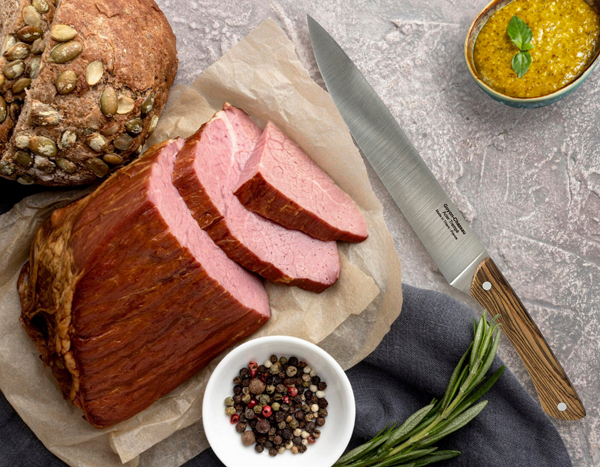
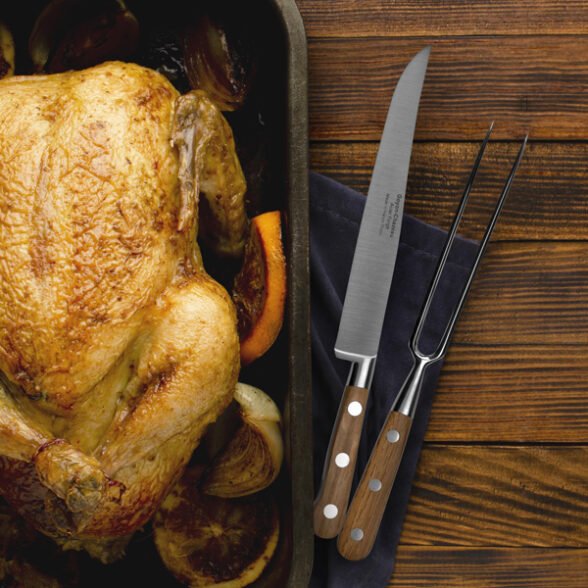
The slicer: thin, even slices
When precision is key—whether you’re preparing cold cuts, a roast to be served in thin slices, or a cut of meat to be sliced evenly—the carving knife (also known as slicer) takes center stage. Its long, narrow, and rigid blade is designed to glide through the meat and produce perfectly even slices, without any jerking motions.
This is a specialty knife, particularly prized by discerning enthusiasts and professionals. It is the perfect complement to the Yatagan carving knife: one for the initial cutting of large pieces, the other for precision slicing. Both are part of GOYON-CHAZEAU’s line of meat knives, forged from nitrogen-enriched X50CrMoV15 steel, renowned for its hardness and ease of sharpening.
The ham knife, for ham and large cuts of cooked meat
The ham knife deserves a special mention. Its flexible, serrated blade—with small indentations along the sides—prevents the meat from sticking to the metal.
The result: long, thin slices that come away on their own, without tearing.
While it obviously excels with cooked or raw ham, it’s also invaluable for slicing any large piece of meat that you want to slice very thinly. It’s an excellent choice for those who entertain often and want to serve their guests with care.

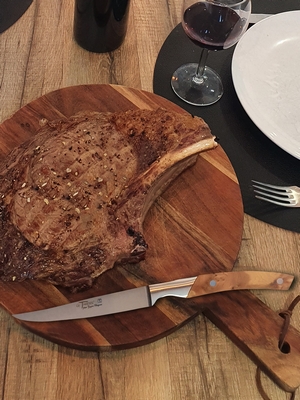
The steak knife, for the dining table
Once the meat has been sliced in the kitchen, the meal continues on the table—and here, too, the knife plays an essential role.
The steak knife bridges the gap between kitchen cutlery and table cutlery: it is a knife specially designed for meat, suited for use at the table.
Its pointed blade, inspired by a smaller version of the carving knife and boning knife, cuts through cooked meat without tearing it. Purists prefer a smooth blade, which cleanly slices through the fibers, while micro-serrations make daily maintenance easier.
Goyon-Chazeau offers its meat knives in its iconic collections, including the very elegant Le Thiers steak knife, for a dining experience that lives up to the quality of the cooking.
Chef’s knives and paring knives: the all-rounders
For smaller cuts—such as duck breast, boneless ribs, or meat that needs to be trimmed or cut into portions—two standard knives are also sufficient.
The chef’s knife, with its wide blade, allows you to cut and portion with confidence.
The smaller paring knife is used for trimming, removing fat, or cutting meat as close to the bone as possible.
These are versatile knives that serve as a useful addition to a meat-cutting set, though they do not replace the long blades needed for large cuts intended for roasting.
Forging, steel, and maintenance: the true measures of quality
Beyond the type of blade, it is the quality of craftsmanship that sets a good meat knife apart.
Forged knives—a hallmark of high-end cutlery—offer the balance, efficiency, and durability sought by both enthusiasts and chefs. Steel that is forged, then hardened, followed by double sharpening, guarantees a long-lasting edge that is easy to restore.
Coutellerie Goyon-Chazeau manufactures its meat knives in La Monnerie-Le-Montel, in the Thiers cutlery region, which has been the French capital of cutlery for over six centuries.
The company offers various lines of kitchen knives, made from cut steel or forged steel. All ranges include meat knives, but differ in style and handle material: cade burl with a peppery scent, olive wood (Le Thiers Cuisine), oak (Tradichef), all-stainless steel, bocote wood, sycamore wood… Each combines character with superior cutting performance.
When it comes to care, a few simple steps can extend the blade’s lifespan: wash by hand with a soft sponge, dry immediately, avoid prolonged contact with water or heat sources, and sharpen the edge as soon as it becomes dull.
A wooden handle regains its luster when wiped occasionally with a drop of linseed or olive oil.
In summary: Choosing the right knife for each type of meat
To carve cooked meat the right way, remember these basics:
- Roast, roast beef, leg of lamb, large poultry → carving knife
- Thin, even slices, cold meat → slicing knife
- Ham and large cuts to be sliced thinly → serrated ham knife
- Table service, individual portions → steak knife
- Small cuts, trimming, portions → chef’s knife or paring knife
The common thread is a forged or cut blade that is very sharp and suited to the size of the cut.
To equip your kitchen, discover the full range of Goyon-Chazeau meat knives: 100% French knives, forged or stamped, handcrafted, designed to slice cooked meat—and much more—with impeccable precision.