
What is the difference between a Laguiole knife and a Le Thiers knife?
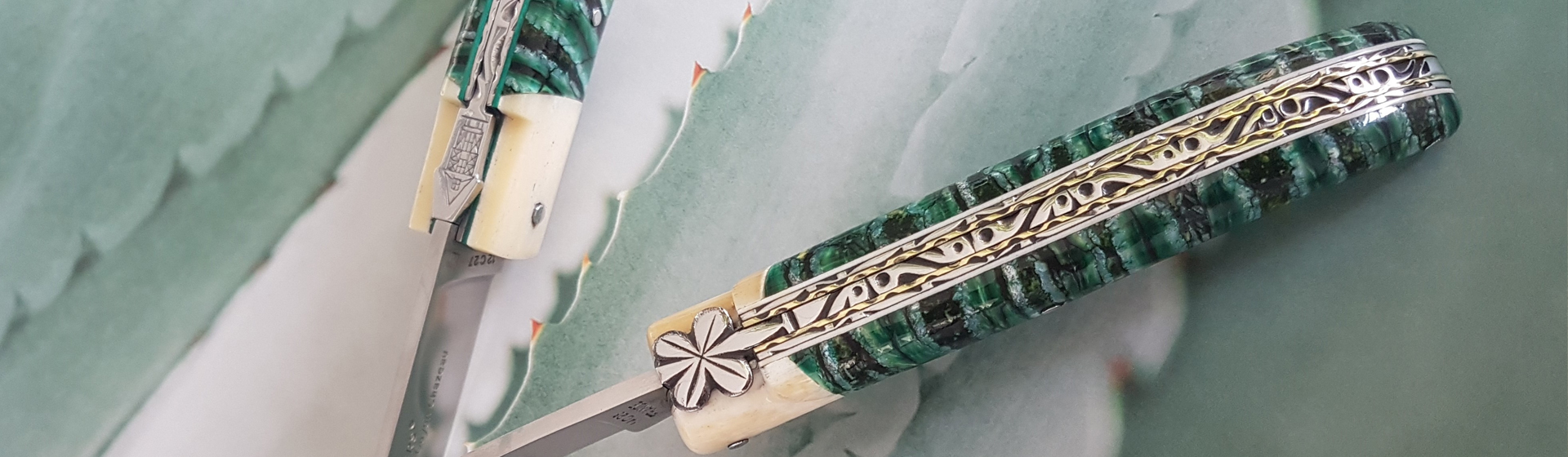
A “Laguiole,” a “Le Thiers”… These two names are everywhere, often found side by side in the same display case, and presented as French classics.
Yet they do not refer to the same history.
The Laguiole is a model that originated in the 19th century in Aveyron, on the Aubrac plateau, recognizable by its curved silhouette, its yatagan blade, and the bee (usually) adorning the top of its spring.
The Thiers® is a much more recent creation. The knife was introduced in 1994, following a collaborative effort by the entire industry and a cooperative initiative unique in Europe. The Thiers® has since been protected by a collective trademark and strict specifications that require, among other things, that the entire production process take place in the Thiers region.
The Laguiole, born in Aveyron in the 19th century
The name comes from the village of Laguiole, in the hills of Aubrac. It is estimated that the Laguiole knife, as we know it today (see below), dates back to the mid-19th century.
At the time, it was a shepherd’s tool: a sturdy folding knife, designed for everyday use. Over time, cutlers added a awl—to make life easier for shepherds in the pastures—and then a corkscrew for people from Aveyron who had moved to Paris to run cafés.
From the very first decades, the cutlers of Laguiole turned to the cutlery-making hub of Thiers to improve their production and source parts, semi-finished knives, and finished knives.
One episode remains little known. Due to the two world wars, production of the Laguiole knife gradually came to a halt in the village. By 1950, there were no longer any cutlers in Laguiole. It was the workshops in Thiers that maintained and expanded the Laguiole knife’s international presence, before a forge reopened in Aveyron in the mid-1980s.
The two regions therefore share a common history, which sheds light on the intensity of current debates over the name and the legitimacy of production.
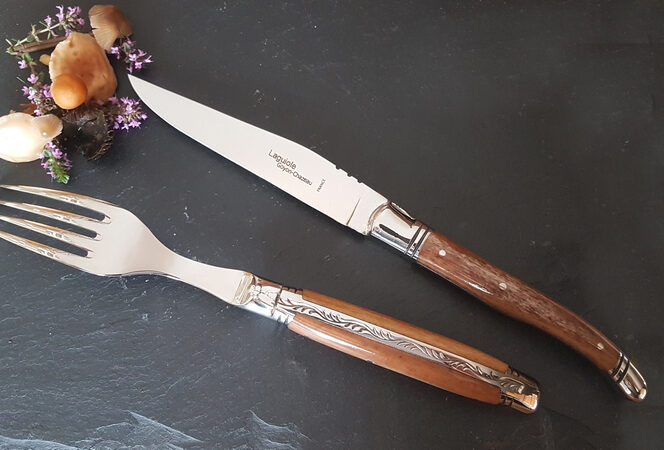
The Laguiole: key distinguishing features
- A “yatagan”-style blade with two broken slopes on the back and featuring a tip that curves upward in a characteristic cutting edge arc.
- A curved silhouette; the handle is contoured and tapers toward the back.
- The “bee” the decorative piece at the top of the spring, most often shaped like a bee.
- High-end Laguiole knives may also feature a chiselled spring, forged bolsters, and a handle made of wood, horn, or precious materials.
Be careful, however: None of these features guarantees the knife’s authenticity. The Laguiole has been and continues to be copied all over the world.
A Regulated Appellation?
For nearly two centuries, the name “Laguiole” remained in the public domain. The extension of Protected Geographical Indications (PGIs) to artisanal products changed the landscape. After two competing applications were filed with the INPI, a contested certification in 2022, and its annulment by the Aix-en-Provence Court of Appeals in July 2024, the designation “Couteau de Laguiole” was officially certified on October 18, 2024.
The “Laguiole GI” specifications—that is, the guidelines defining which Laguiole knives are entitled to the Protected Geographical Indication designation and thus to the logo—limit the production area to 24 municipalities in northern Aveyron, thereby excluding knives manufactured in Thiers.
In practice, a Laguiole knife manufactured in Thiers in the Puy-de-Dôme department remains perfectly legitimate, as the craftsmanship has been established there for over a century; however, its manufacturer simply cannot claim this official designation.
The case regarding the “Laguiole knife” Protected Geographical Indication is not closed: an appeal to the Court of Cassation has been pending since 2024 and aims to expand the geographical area to include the production of Laguiole knives in Thiers.
Thiers: a cutlery city before being a knife name
Thiers is first and foremost a town in the Puy-de-Dôme department, at the heart of France’s largest cutlery-making region for the past six to eight centuries.
Blacksmiths, polishers, assemblers, and suppliers of spare parts… have long produced the blades and components for knives from all regions here: Aurillac, Langres, Normandy, Issoire—and Laguiole.
Used in a broad sense, the term “Un Thiers” (= ” a Le Thiers knife”) thus refers to a geographical origin, not a specific design.
With its article and registered trademark, LE THIERS® refers, however, to a specific knife design—one that is increasingly compared to the “Laguiole.”
Le Thiers®, created in 1994
LE THIERS® was born out of a paradox: the capital of French cutlery was producing and manufacturing knives for every region without having its own iconic knife! A group of passionate manufacturers therefore came together in the early 1990s to fill this gap.
The prototype was unveiled on November 7, 1994, and this new line was registered with the INPI by the Confrérie du Couteau LE THIERS®, which owns the name and logo. Each member is then free to offer their own interpretation of the design while adhering to a common set of standards, which ultimately results in a wide variety of models and finishes.
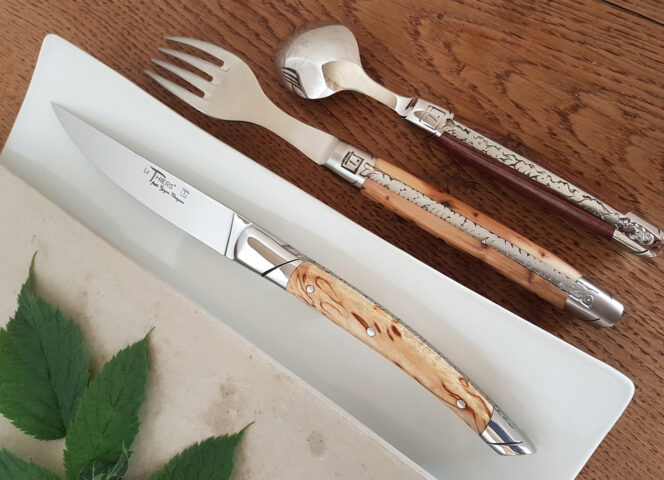
Le Thiers®: key identification features
- A double-wave line and a handle that tapers in the opposite direction at the ends—higher toward the blade than at the tip.
- The inscription “LE THIERS®” on the blade, followed by “by” (or “par” in french) and the manufacturer’s name.
- The “T.” hallmark, representing the French mark, is present on the knife and guarantees its origin and manufacture.
- LE THIERS® knives range from mid-range to luxury models, featuring all types of materials and finishes.
This is where the structural difference lies compared to its older counterpart in Aveyron.
To affix the LE THIERS® mark to a knife, one must be based in the region, be a member of the Confrérie, and submit a prototype to the Jurande—a council of experts that verifies technical, quality, and geographical compliance. Every component and every step of the process must be carried out in the Thiers cutlery region. Whereas the former designation was long open to all, the latter was restricted from the very beginning.
| Laguiole
|
Le Thiers® |
|
| Origin
|
The village of Laguiole, Aveyron, Aubrac Plateau |
Thiers cutlery region, Puy-de-Dôme |
| Creation
|
Mid-19th century |
November 7, 1994 |
|
Status of the name |
Long unprotected; |
Collective trademark registered from the outset |
| Silhouette
|
Curved, yatagan blade with an upturned tip
|
Double wave, slightly downward-sloping tip |
|
Distinctive Mark |
The “bee,” often depicted as a bee |
Name “LE THIERS®” after the manufacturer’s name |
|
Inspection |
Certification body for products bearing the designation |
Oath of the Brotherhood
|
Laguiole or Le Thiers®—which one should you choose
based on your intended use and budget?
In Your Pocket
One goes for the universally recognized classic style, while the other appeals with a more contemporary design and crystal-clear traceability, since the manufacturer’s name is engraved on the blade. For one-handed opening, check out the forced-notch or liner-lock versions, available in both lines.
On Table
Forged cutlery is judged primarily on how well-balanced it feels in the hand and on its finish. The quality of craftsmanship matters far more here than the chosen design.
As a Gift
Both types lend themselves to personalized engraving: initials, a date, or a company logo. It’s this engraving that transforms a mass-produced item into a one-of-a-kind piece.
Pricing
The price depends very little on the design chosen. It ranges from a few dozen to several hundred euros. The type of knife (table/pocket), the origin of the materials, whether it’s forged or cut, the number of manual steps, and the time required for finishing all contribute to the price.
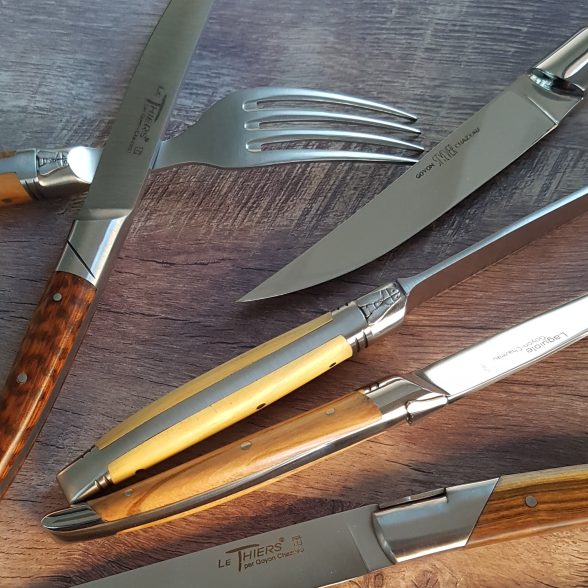
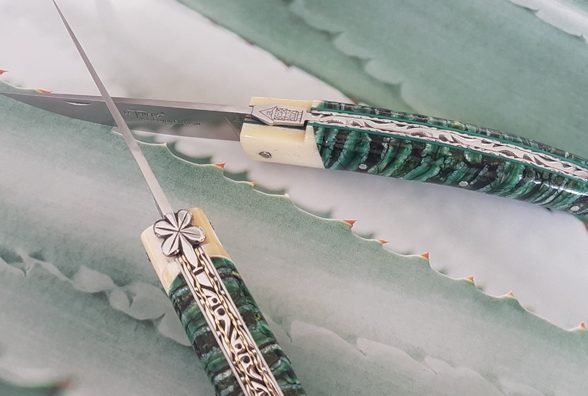
What really matters: the forging process, the material, and the finish
The name tells you what the object looks like; it says almost nothing about its quality. Three criteria are more decisive.
- Forged blade or stamped (cut) blade. Forging compacts the steel’s structure under the hammer, giving it strength and durability. Stamping a blade from a sheet requires fewer manufacturing steps and is therefore less expensive to produce. Both have their market, but they are not the same products.
- The edge profile. This shape given to the cutting edge makes the difference between a blade that cuts straight and one that pushes and tends to skew the cut.
- Hand finishing. Adjusting the bolsters, polishing the wood or horn, ensuring there is no gap: these take hours of workshop work, and the results are evident.
The materials also deserve a mention. A handle made of fine wood ages well but requires minimal maintenance; horn gives each piece a unique character; technical materials and Damascus steel are chosen for their durability and aesthetic appeal, respectively. This choice comes down to personal taste, but it affects both the price and the pleasure of use.
At GOYON-CHAZEAU, an artisanal workshop based in La Monnerie-le-Montel, in the Thiers cutlery region, forged knives and stamped steel knives are crafted from materials sourced exclusively from the Thiers region through short supply chains. The state-awarded “Entreprise du Patrimoine Vivant” (Living Heritage Company) label, granted in 2013 and 2018, recognizes this mastery of cutlery craftsmanship, blacksmithing, stainless steel welding, and the manufacture of hollow handles.
Frequently Asked Questions
Is a Laguiole knife from Thiers a “fake”?
No. The Puy-de-Dôme region has been producing Laguiole knives since the 19th century, long before the knife gained widespread recognition. In fact, it was the knife-making industry in Thiers that kept the model alive during the decades when there was no longer any knife production in Aveyron.
It is not a counterfeit: simply, the official geographical indication (GI), approved in 2024, can no longer be claimed outside its designated area.
Knife makers in Thiers may continue to produce Laguiole knives but are not permitted to engrave them with the GI logo.
Does the bee guarantee authenticity?
No, it’s a decorative motif that can be freely reproduced. To determine the knife’s origin, look for the manufacturer’s name on the blade and check the place of manufacture. A Laguiole knife that is 100% made in France is a guarantee of authenticity.
How can you identify the manufacturer’s markings?
A craftsman who makes the knife signs his work. An engraving at the heel of the blade, a hallmark, or sometimes a serial number: these markings are the first things to check in a store. Their absence isn’t a deal-breaker, but it’s worth asking the salesperson about it.
To Learn More
These two models aren’t opposites: they represent two different periods in the history of French cutlery. The only true judge is your own eye and hand—try holding both, and your personality will reveal which one suits you best.
Discover our Le Thiers® knife collection, our LE THIERS tableware, or browse our entire selection of forged and cut creations.
And to learn the full story behind the Le Thiers® knife, click here!


