
How to prepare and cut raw meat before cooking?
In our article “Which knives for cutting meat?”
” we introduced you to all the knives used for working with meat.
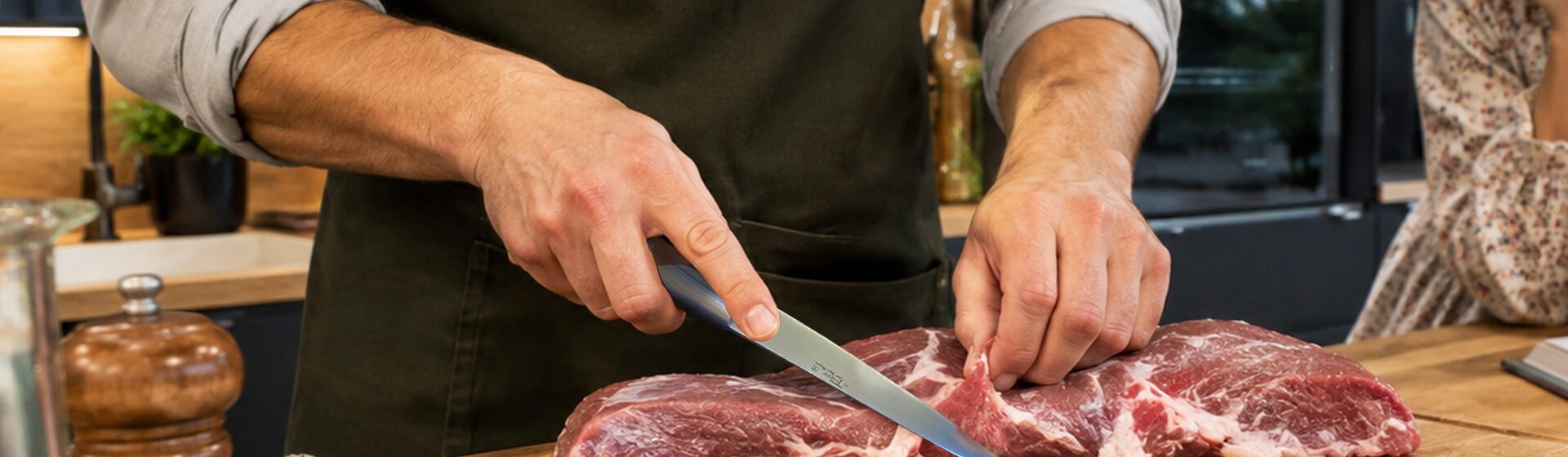
Here, let’s explore the meat knives best suited for preparing and cutting raw meat—an essential step in cooking that begins well before cooking and serving.
In fact, a clean cut not only produces uniform pieces that look attractive on the plate, but also preserves the meat’s texture, minimizes juice loss, and makes cooking easier. However, not all knives are suitable for this task.
Contrary to popular belief, there isn’t just one type of knife for working with raw meat. Depending on the size of the cut, and whether it contains bones, fat, or tendons, certain models will be more suitable than others.
For example, deboning poultry, preparing a roast beef, or trimming a pork tenderloin all require different knives.
Choosing the right knife, knowing the proper cutting techniques, and following a few simple care guidelines will allow you to prepare meat with precision, efficiency, and safety.
Why use a knife designed for raw meat?
Raw meat has a complex structure made up of muscle fibers, fat, membranes, and sometimes bones.
Learning to cut meat properly means learning not to crush the flesh, to follow the grain of the fibers, and thus to retain as much of the juices as possible.
An unsuitable meat knife crushes these elements instead of slicing through them cleanly.
A perfectly sharpened blade therefore offers several advantages:
- a clean and precise cut;
- less effort required, making the task faster;
- better presentation of the cuts and more uniform portions;
- optimal retention of the meat’s juices;
- greater safety: it’s proven that you’re less likely to injure yourself with a blade that cuts well!
That’s why professionals, particularly butchers, use knives designed specifically for working with raw meat.
Does the length of a knife blade matter?
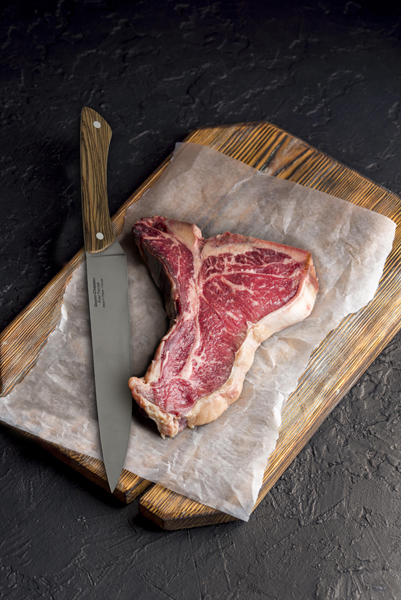
Blade length is a factor that is often underestimated when choosing a knife. However, it directly affects the quality of your technique and, therefore, the cut: A blade that is too short forces you to make more movements and results in uneven cuts. Conversely, a blade that is too long becomes difficult to control when working with small pieces.
Here are some general guidelines:
- 13 to 15 cm: deboning, removing tendons, trimming, and poultry;
- 18 to 20 cm: a versatile knife for most meats;
- 20 to 25 cm: carving roasts and large cuts;
- 30 cm: hams and very large cuts.
The goal is to make the cut while preserving the integrity of the fibers; the larger the piece, the longer the blade should be to allow for cutting with as few strokes as possible.
Which knife should you choose based on the type of meat?
Each type of meat has its own characteristics. The size of the cut, its density, and whether it contains bones all directly influence the choice of knife.
Here is a chart to guide you:
|
Type of meate |
Meat characteristics | Recommended knife |
Recommended blade length |
|
|
|
|
|
| Beef | Thick, fibrous cuts. | Carving knife: wide cutting motions without tearing the meat
or boning knife: For trimming a tenderloin or removing membranes |
20 to 25 cm |
|
|
|
|
|
| Veal | Tender meat
fine fibers |
Chef’s knife: to cut even pieces while preserving the meat’s natural tenderness and texture | 18 to 20 cm |
|
|
|
|
|
| Pork | Fatty cuts and cuts requiring deboning | Boning knife: for removing bones and tendons
+ carving knife: for portioning the meat |
13 cm
20 cm |
|
|
|
|
|
| Lamb | Requires precise work around the bones | Boning knife: a short, maneuverable blade makes it easier to follow the bone structure and minimizes meat loss | 13 to 15 cm |
|
|
|
|
|
| Poultry | Requires precision and control | Boning knife: its fine tip allows you to follow the joints and separate the meat with precision | 13 cm |
|
|
|
|
|
| Game | Contains more tendons and membranes | Boning knife or trimming knife: for trimming
+ chef’s knife: for portioning—an effective combination. |
13 to 20 cm |
|
|
|
|
|
| Cured ham | Rind, fat, and meat require different handling
Meat rich in flavor and texture that must be preserved |
Boning knife or trimming knife to remove the rind or excess fat
+ Ham knife to make large, fluid, continuous, and smooth cuts to produce thin, even slices without tearing the meat |
20 to 25cm
30 cm |
The Essential Duo for Preparing Raw Meat
If you had to choose just two knives for cutting raw meat:
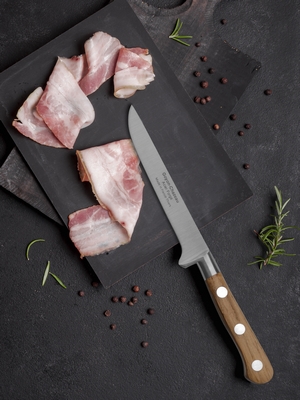
The boning knife remains the go-to tool for working with raw meat. Its short, pointed blade allows you to follow the bones, remove tendons, and trim excess fat with precision. The 13-cm models are particularly popular for their ease of handling.
For cutting and slicing large cuts of meat, the carving knife is an excellent complement thanks to its long, thin blade, which cuts easily through the meat without tearing it.
This combination allows you to efficiently prepare beef, pork, lamb, poultry, or game while achieving a cut quality close to professional standards.
Techniques for Properly Cutting Raw Meat
Work with the Meat at the Right Temperature
The temperature of the meat greatly affects the quality of the cut.
Slightly chilled meat is generally easier to work with than meat at room temperature. The fat remains firmer, the fibers hold their shape better, and the knife glides more easily.
For optimal cutting:
- store the meat between 2 °C and 6 °C;
- take the cut out of the refrigerator only a few minutes before cutting;
- avoid meat that is too warm or partially thawed (except for certain very thin cuts).
Butchers often use this natural firmness caused by cold temperatures to achieve more precise cuts.
Cut Across the Grain
One of the fundamental rules is to identify the direction of the muscle fibers.
To make the meat more tender after cooking, you should cut perpendicular to the direction of the fibers. This technique shortens the fibers and improves the texture in the mouth.
The meat then becomes more tender after cooking and more enjoyable to eat.
Use a Gliding Motion
Many cooks make the mistake of pressing down vertically on the meat.
An effective cut, on the other hand, combines light pressure with a gliding motion of the blade. This technique results in a cleaner cut while requiring less effort.
The knife then naturally cuts along its edge, requiring less effort.
Deboning by Following the Bone
When deboning, keep the tip of the knife in contact with the bone and use small, steady movements to separate the meat without wasting any.
This technique is particularly effective for poultry and leg of lamb.
The Importance of a Perfectly Sharp Edge
A meat knife must be perfectly sharp.
Contrary to popular belief, a dull knife is more dangerous than a sharp one. It requires more force and increases the risk of the knife slipping and causing injury.
Here are some best practices to follow to maintain your knife’s optimal performance:
- Use a sharpening steel before each use;
- Perform a full sharpening when the edge loses its effectiveness;
- Never wait until a knife is completely dull to maintain it.
Professionals consider regular sharpening an essential step before working with meat.
Regular maintenance ensures consistent cutting quality and extends the knife’s lifespan.
For knives with wooden handles, occasional treatment with a suitable oil also helps preserve the material’s appearance and durability.
How do you care for a meat knife?
Raw meat requires strict hygiene rules.
Therefore, for each use:
- use a clean, stable cutting board;
- immediately wash the blade with lukewarm water and a soft sponge;
- dry the knife thoroughly; avoid prolonged exposure to moisture;
- store the knife in a dry place;
Using the dishwasher is not recommended, as it will dull the blade and accelerate wear and tear on the knife.
For wooden handles, occasionally applying a suitable oil (linseed oil) helps preserve their appearance and ensures they remain comfortable to use.
Cutting raw meat properly depends on more than just technique. The choice of knife, the length of the blade, the temperature of the meat, and the maintenance of the edge all play a decisive role in the final result and the dining experience.
The right equipment not only saves time in the kitchen by allowing for greater precision, but also makes the work more enjoyable, ensures optimal conditions, and, ultimately, allows you to fully appreciate the quality of the meat.

A boning knife is the most versatile tool for working with raw meat.
For large cuts, a carving knife offers greater comfort and precision.
Meat that is slightly chilled is generally easier to cut because the fibers and fat are firmer.
A 13-cm blade for deboning, a 20-cm blade for everyday cutting, and up to 30 cm for hams and large cuts.
Yes, but a specialized knife will be more effective for deboning, removing tendons, or slicing meat cleanly.
Regular sharpening, hand washing, and proper storage will help maintain the cutting quality of your meat knives over the long term.


